
Why Tree Roots Damage Your Sewer Line
Summer in North Texas is when sewer lines take their worst beating, and most homeowners never see it coming. The ground dries out, cracks open across the yard, and every tree on the property starts hunting for water it cannot find near the surface. Your sewer line carries a steady flow of warm water and nutrients, so it becomes the most attractive target in the soil. Roots do not attack pipe out of aggression; they simply grow toward moisture and grow through anything that gives them an opening. A joint that leaks a teaspoon a day releases enough vapor to pull roots in from several feet away. Once a hairline root slips inside, it thickens season after season until it fills the pipe like a plug. Homeowners in Burleson, Crowley, Joshua, and Fort Worth call us every July and August with slow drains they blame on hair or grease, and the camera shows a wall of white root hair instead. Understanding how this happens gives you a real chance to stop it before the line collapses. This guide explains why tree roots damage your sewer line, what the early warning signs look like, and what a plumber can actually do about it.
Why Tree Roots Damage Your Sewer Line in North Texas Soil
Tree roots damage sewer lines because pipes offer exactly what a stressed tree needs during a Texas summer: water, oxygen, and nutrients in one place. Our region sits on expansive clay soil that swells when wet and shrinks hard when dry, and that constant movement pulls pipe joints apart over time. Older neighborhoods around Burleson and Fort Worth still have clay tile, Orangeburg, and early cast iron lines with joints that were never watertight to begin with. Add decades of soil movement, and small gaps turn into open invitations. Roots find those gaps, squeeze through, and then expand with enough force to crack the pipe wall outright. The damage compounds because a root mass traps toilet paper, grease, and solids, which turns a small intrusion into a full blockage. Knowing the mechanics helps you spot trouble early instead of after sewage backs up into a tub.
How Tree Roots Find and Damage Your Sewer Line
Roots do not sense pipe; they sense moisture gradients in the soil. When a sewer joint weeps even slightly, warm water vapor escapes into the surrounding dirt and creates a small zone of higher humidity. Fine feeder roots grow toward that zone the same way they would grow toward a leaking irrigation head. When a root reaches the gap, it enters as a strand thinner than a thread, small enough to pass through a crack you could barely see with a flashlight. Inside the pipe, conditions are close to perfect for growth: constant moisture, steady warmth, and a nutrient load that no garden soil can match. The root responds by branching into a dense mat that looks like a horse tail hanging in the flow. As it thickens, it exerts outward pressure on the pipe wall, widening the original crack and creating new ones. That is the point where a minor intrusion becomes structural damage to the sewer line.
The speed of this process surprises most homeowners. A single growing season can take a root intrusion from a few strands to a mass that blocks half the pipe diameter. Summer heat accelerates it because trees push root growth outward when surface moisture disappears. Every flush feeds the mass with more water and more organic material, so the pipe becomes a reliable food source the tree will keep exploiting. Roots also follow the path of least resistance, which means they travel along the length of the pipe once inside rather than stopping at the entry point. We have pulled root masses more than fifteen feet long out of a single lateral. The tree above ground shows no stress at all, because it has found the best water source on the property. Nothing about the tree’s appearance will warn you.
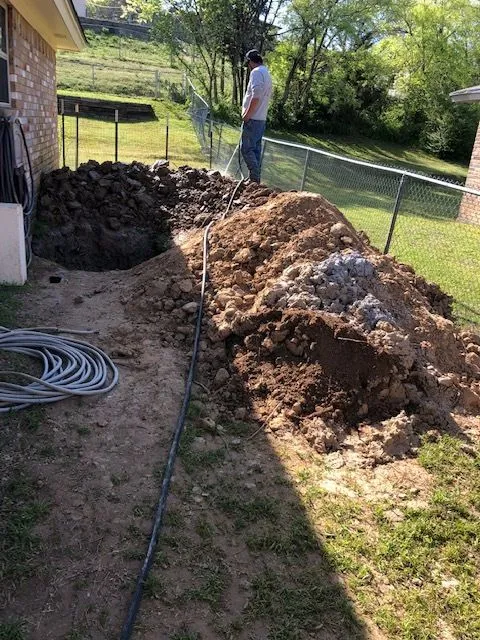
Damage does not stop at blockage. A root wedged in a joint acts like a lever every time the clay soil shifts, which slowly offsets the pipe sections. Offset joints let soil and sand wash into the line, and that sediment settles in low spots and reduces flow further. Water then escapes into the surrounding dirt, which softens the bedding under the pipe and causes the line to sag into a belly. A bellied sewer line holds standing waste, which speeds corrosion in cast iron and creates a permanent clog point. Meanwhile the escaping water keeps drawing more roots to the same spot. This is the cycle that turns a repairable intrusion into a full line replacement. Catching it in the first stage is dramatically less expensive than catching it in the last.
Warning Signs Tree Roots Are Damaging Your Sewer Line
The earliest sign is almost always a gurgle. When a root mass partially blocks the line, air trapped behind the water has to escape somewhere, and it pushes back through the nearest trap. You hear it as bubbling in a toilet bowl when the washing machine drains, or a glug from a tub when someone flushes down the hall. Most people ignore this because nothing has overflowed yet. Pay attention to it anyway, because gurgling means the line is already restricted. Another early signal is a toilet that empties slowly and then refills to an odd water level. Multiple fixtures acting strangely at the same time points to the main line rather than a single drain. One slow sink is a fixture problem; a slow sink plus a slow tub plus a noisy toilet is a sewer problem.
Yard clues matter just as much as indoor clues. In the middle of a dry Texas August, look for a strip of grass that stays green and lush when everything around it has gone brown. That strip usually runs in a straight line from the house toward the street or toward a septic area, and it is green because your sewer line is irrigating it. Soft or spongy ground along the same path means water is leaving the pipe in volume. Sinkholes, small depressions, or a section of driveway that has settled unevenly can indicate soil washing out around a broken line. Odor is another giveaway; a sewer smell outdoors near the cleanout is never normal. Indoors, a persistent sewer odor in a bathroom often traces back to a cracked line rather than a dry trap. Any one of these signs justifies a camera inspection.
Recurring clogs are the sign homeowners most often misread. When a drain backs up, gets cleared, and then backs up again two months later, the underlying cause was never removed. Cable machines with standard heads often punch a hole through a root mass without cutting it out, which restores flow temporarily while leaving the roots in place. The mass regrows quickly because you just gave it fresh water and pruned it. If you have called someone out more than once in a year for the same main line, roots are the most likely culprit in an older North Texas neighborhood. Backups that get worse during heavy rain point the same direction, since saturated soil and swelling clay squeeze compromised joints. Track the dates of your backups and look for a pattern. That pattern is diagnostic information a good plumber will want to hear. Suspect roots in your main line? Click here for our sewer line inspection service.
Which Trees Cause the Most Tree Root Sewer Line Damage
Not every tree poses the same risk to your sewer line, and the worst offenders are common across Johnson and Tarrant counties. Willows top nearly every list because they are aggressive water seekers with shallow, far reaching root systems. Silver maples, cottonwoods, and sycamores follow closely; all three grow fast and send roots well beyond the drip line. Hackberry is extremely common in our area and far more invasive than most homeowners realize. Live oaks and red oaks grow more slowly but produce thick structural roots capable of crushing older pipe outright. Even ornamental species like Bradford pear and crape myrtle can find a leaking joint when they are planted directly over the line. Bamboo and privet hedges cause problems out of proportion to their size because of dense, opportunistic root networks.
Distance from the pipe matters more than species in most cases. A general rule is that a tree’s roots extend at least as far as its canopy and often two to three times farther in dry conditions. That means a mature pecan sitting forty feet from your cleanout can absolutely reach the line. Planting a new tree within twenty feet of a known sewer route is asking for a service call in ten years. If you are landscaping this summer, find out where your lateral runs before you dig; the cleanout near the foundation and the connection at the street will give you the general path. Choosing species with less aggressive roots is smart, though no tree is truly safe over a compromised line. Physical root barriers installed vertically in the soil can redirect growth downward and away. Barriers work best when installed before roots have established a route.
Removing a tree does not automatically solve a root problem, and that surprises people. Roots already inside the pipe will decay after removal, but the decaying mass can still block flow for a long time and must be cleared mechanically. The stump and root system also break down slowly in clay soil, which can leave voids that let the pipe settle. Removal is worth considering when a tree is planted directly over the lateral and repairs have already failed once. In many cases the better answer is keeping the tree and fixing the pipe, since a sealed line gives roots nothing to grow toward. That is the core principle worth remembering: roots exploit failing pipe, they do not create failure in sound pipe. Address the pipe, and the tree stops being a plumbing issue. A camera inspection tells you which category your situation falls into.
How to Stop Tree Root Damage in Your Sewer Line
Stopping root damage takes two steps that have to happen in order: clear what is already inside, then close the openings that let roots in. Skipping the second step guarantees a repeat visit, usually within a year. Hardware store root killers have a place as a maintenance tool, but they cannot restore a cracked joint or an offset section. The right approach starts with seeing the inside of the pipe, because guessing at the location and severity of an intrusion wastes money. From there, a plumber can match the solution to the actual condition of the line. Some homes need a thorough cleaning and an annual maintenance plan. Others need a spot repair, a liner, or a full replacement, and the camera is what tells you which.
Sewer Line Inspection Finds Tree Root Damage Before It Spreads
A camera inspection is the only way to know what is happening inside a buried sewer line. We feed a waterproof camera on a flexible push rod through the cleanout and travel the full length of the lateral to the city connection. The video shows root intrusions, cracks, offset joints, bellies, grease buildup, and pipe material, all with distance markers so we know exactly how far from the house each problem sits. A locating transmitter in the camera head lets us mark the position on the surface with a receiver, which means any future digging happens in the right spot the first time. That precision saves enormous amounts of money on repair. Without it, excavation becomes a search operation across your yard. The inspection also documents the condition of the entire line, not just the section causing today’s symptom. That full picture is what allows honest recommendations.
The findings drive very different plans. A single root mass at one joint in otherwise solid pipe is a straightforward repair with a good long term outlook. Roots at eight separate joints along a run of old clay tile tells a different story, and patching one spot would be a waste of your money. We also look for what the roots have already caused, since an offset joint or a belly changes the repair strategy entirely. Pipe material matters too; PVC installed in the last thirty years fails differently than clay tile from the 1950s. Knowing the material tells us how the line will respond to cutting tools and to lining. All of this comes from twenty minutes of video that costs a fraction of a repair.
Inspections are just as valuable when you are buying a house. Standard home inspections do not include a sewer camera, and a buyer can close on a property with a root filled lateral without ever knowing. In older Fort Worth, Haltom City, and River Oaks neighborhoods with mature trees, that risk is real and the repair costs are substantial. A camera inspection before closing gives you leverage in negotiation or a clear reason to walk away. Existing homeowners with large trees benefit from an inspection every two to three years as basic maintenance. If you have had one backup already, put the inspection on a shorter cycle. Documentation over time also shows how fast a known problem is progressing, which helps you plan and budget instead of reacting to an emergency.
Hydro Jetting Removes Tree Root Damage From Your Sewer Line
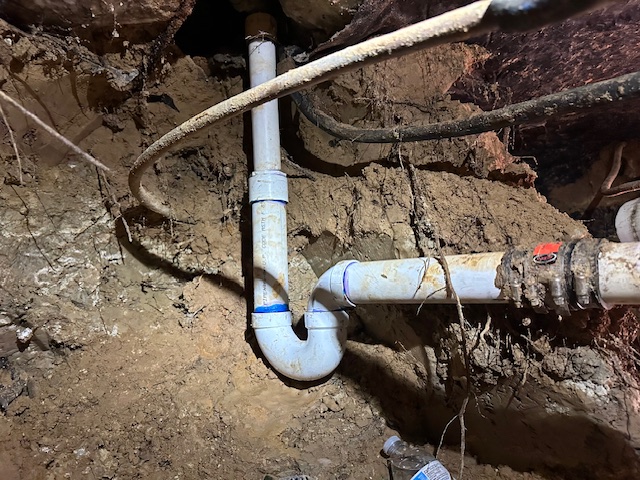
Cable machines and hydro jetting solve different problems, and confusing the two leads to repeat backups. A cable machine spins a steel snake with a cutting head, and it is excellent at boring through a blockage to restore flow fast. What it does not do well is clean the full inner wall of the pipe. The head follows the path of least resistance, which often means it opens a channel through the center of a root mass and leaves the rest attached. Hydro jetting uses water at very high pressure through a specialized nozzle that sprays forward and backward at once. The forward jets cut roots and break up the blockage; the rear jets propel the hose and scour the pipe walls as it travels. The result is a pipe cleaned back toward its original diameter, with root mass and the grease and sediment that fed it flushed out to the main.
Root cutting nozzles take this further with rotating heads designed specifically for intrusions. They shear roots off flush at the pipe wall instead of tearing at them, which slows regrowth considerably compared to a cable pass. Jetting also removes the sludge layer that roots anchor into, so what is left has less to hold onto. For homes with a known root problem and pipe that is still structurally sound, an annual or every other year jetting appointment is a practical maintenance strategy. It is far cheaper than replacement and keeps the line usable for years. The technique does have limits and requires judgment. Fragile clay tile, badly deteriorated cast iron, and Orangeburg pipe can be damaged by high pressure water, which is exactly why the camera inspection comes first.
Timing matters more than most people expect. Late summer and early fall are the best windows for preventive jetting in North Texas, because root growth surges during the dry stretch and slows as temperatures drop. Clearing the line at the end of the growing season means going into winter with a clean pipe. It also gets ahead of the holidays, when heavy kitchen use and full houses put maximum demand on a marginal sewer line. Scheduling maintenance work now costs less than emergency work in December. Nobody wants a main line backup on Thanksgiving morning, and we see several every year. Ready to clear roots out of your line for good? Click here for our hydro jetting service.
Sewer Line Repair Options After Tree Root Damage
When roots have compromised the pipe itself, cleaning alone is a temporary measure and repair becomes the real answer. The least invasive option is a spot repair, where we excavate a short section, cut out the damaged piece, and install new pipe with proper couplings. This works well when the camera shows one clear failure point in a line that is otherwise in decent shape. It is quick, the yard damage is limited, and the cost is manageable. The catch is that a spot repair only fixes what you dig up. If the rest of the line is the same age and material, other joints will follow within a few years. The inspection footage is what tells us honestly which situation you are in.
Trenchless methods have changed sewer repair significantly for homes with mature landscaping. Cured in place pipe lining pulls a resin saturated liner through the existing pipe and cures it into a new seamless pipe within the old one. Because the finished liner has no joints, roots have nothing to enter, which permanently ends intrusion in the lined section. Pipe bursting is the other trenchless option, using a head that fractures the old pipe outward while pulling new HDPE pipe into the space behind it. Both approaches need only small access pits rather than a trench across the yard, which protects trees, driveways, patios, and sprinkler systems. Not every line is a candidate; severe collapses, major offsets, and hard bellies usually have to be dug. Cost sits between a spot repair and a full replacement, and the working life is measured in decades.
Full replacement by open excavation remains the right call in certain cases. A line with multiple failures, a severe belly, badly deteriorated Orangeburg, or a bad slope will not be fixed by lining, since lining preserves the existing shape and grade. Replacement lets us correct the slope, upgrade the material to modern PVC, reroute around problem trees, and add cleanouts that make future maintenance simple. Yes, it disturbs the yard, and yes, it is the largest investment of the three options. It is also the only one that resets the clock completely on a line that has reached the end of its service life. We walk through the camera footage with you and explain what each option realistically buys in years of service. Need a permanent fix for a damaged line? Click here for our sewer line repair service.
Why You Need a Licensed Plumber for Tree Root Sewer Line Damage
Root damage sits at the intersection of plumbing, soil conditions, and pipe age, and getting the diagnosis wrong is expensive. A store bought chemical, a rented snake, or a quick cable pass from a low bid outfit can all restore flow for a while without touching the actual problem. Meanwhile the roots keep widening the openings and the pipe keeps deteriorating under your yard. A licensed plumber brings camera equipment, jetting capability, locating tools, and the experience to read what the video is showing. Just as important, a licensed plumber knows Texas code and pulls the permits that repairs and replacements require. Big Blade Plumbing & Rooter has handled sewer and drain work in Burleson and the surrounding area since 2007. We tell you what your line actually needs and what it does not.
Why Store Bought Treatments Fall Short on Tree Root Sewer Line Damage
Copper sulfate crystals are the most common product homeowners try, and the results rarely match the label. The crystals are heavy and tend to settle in the trap or the first low spot in the line rather than reaching the intrusion. Even at the right spot, copper sulfate kills only the root tissue it directly contacts, which leaves the dead mass sitting in the pipe as a blockage. It can also damage the tree if enough reaches the main root system, and some municipalities restrict what may be introduced into the sewer. Foaming herbicide products perform better because the foam expands to contact the top of the pipe where roots hang, though they still do not remove the mass or repair the opening. These products are maintenance tools at best, useful after mechanical cleaning has already cleared the line.
Rented drain augers create their own set of problems. The cable can wrap around a root mass and bind, and freeing a stuck cable from a buried line sometimes means excavating to retrieve it. Undersized equipment cannot generate the torque to cut real roots and just polishes the mass instead. In older clay tile, an aggressive head in inexperienced hands can crack the pipe and turn a cleaning job into a repair job. There is also no feedback with a rented machine; you cannot see what you hit, how far away it is, or what condition the pipe is in. You end up guessing about the most expensive plumbing component on your property.
The deeper issue with every do it yourself approach is that none of them close the entry point. Roots came in because the pipe has an opening, and that opening is still there after the chemical treatment or the snake. Growth resumes immediately, fed by the same water and nutrients as before. Homeowners often spend several years and a good deal of money on repeated temporary fixes before addressing the actual pipe. That money would have covered a real repair. Getting a clear diagnosis first puts your budget toward a solution instead of a cycle.
What to Expect When We Handle Tree Root Sewer Line Damage
Our process starts with a conversation about symptoms, history, and the age of your home, because that context narrows the possibilities before we open anything. We locate the cleanout, or install one if the house does not have accessible access, and run the camera through the full length of the lateral. You watch the footage with us in real time and we explain what each finding means in plain language. Roots, cracks, offsets, and bellies all look different on screen, and we point them out as we pass them. We mark the location of any problem area on the surface so you can see exactly where it sits in your yard. There is no mystery and no vague talk about needing major work.
From there we lay out the options and what each one realistically accomplishes. Sometimes the answer is a jetting appointment and a maintenance schedule, and we will tell you that even though it is the smaller job. Other times the footage shows a line at the end of its life, and we explain why cleaning it again would only buy a few months. You get pricing on the options that actually apply to your situation, not a menu designed to steer you upward. We answer questions until the decision makes sense to you. Honest recommendations without pressure is not a slogan for us; it is how we have kept customers since 2007.
When repair work is scheduled, we handle permits, coordinate with the city on connection requirements, and protect your property while we work. Access pits and trenches get backfilled and compacted properly so the ground does not settle later. We run the camera again after the work is finished so you can see the result for yourself. You also get guidance on protecting the line going forward, including planting distances and a realistic maintenance interval for your specific yard. Emergencies do not wait for business hours, and we respond fast when a main line backs up. A sewer backup is a health issue, not just an inconvenience.
Why Choose Big Blade Plumbing & Rooter for Tree Root Sewer Line Damage
We have been a licensed plumbing contractor since 2007, and sewer and drain work is core to what we do every day. Root intrusions in North Texas clay soil are a specialty born of repetition; we know which neighborhoods have clay tile, which have cast iron, and where the common failure points sit. That local knowledge shortens diagnosis and gets you a straight answer faster. Our work covers residential and commercial properties, from a single family home in Rendon to a restaurant in Fort Worth with a grease loaded lateral. Same equipment, same standards, same honest assessment.
Our reputation rests on workmanship that holds up. We do not upsell a replacement when a repair will serve you well, and we will not clean a line repeatedly while pretending the underlying problem does not exist. Quality work focused on long term reliability means using the right pipe material, setting proper slope, and sealing joints correctly so you are not calling anyone back in two years. When we quote a job, the scope is clear and the price is the price. That approach has built a customer base across Burleson, Crowley, Joshua, Mansfield, Cleburne, Arlington, Keller, and the surrounding communities.
Give us a call at (817) 517-2425 or email info@bigbladeplumbingandrooter.com to schedule an inspection or discuss what your line is doing. We are located at 2113 S Burleson Blvd in Burleson and we serve the entire southern Fort Worth area. Summer is the season roots do their worst damage, so now is the right time to find out what is happening under your yard. A camera inspection today is far less costly than an emergency excavation later. Let us take a look and give you a straight answer.