
Signs of A Hidden Water Leak Behind Walls
A hidden water leak behind a wall rarely announces itself. It starts small, often as a pinhole in a copper supply line or a loose fitting inside a bathroom wall cavity, and it soaks framing and insulation long before anything shows up on the painted surface. By the time a stain appears, the leak has usually been running for weeks. Summer makes the problem harder to catch in North Texas, because irrigation systems, pool fills, and heavy air conditioning use push water bills up anyway, so an extra few thousand gallons blends right into the seasonal average. Homeowners in Burleson, Crowley, and Fort Worth call us every July with the same story; the bill looked high, nobody thought much of it, and then the baseboard went soft. Catching a concealed leak early protects your drywall, your framing, your flooring, and your indoor air quality. The signs are there if you know what you are looking at. This guide walks through the warning signs, the common causes, and what a professional does to locate the leak without tearing your house apart.
Early Warning Signs of a Hidden Water Leak Behind Walls
Concealed leaks give off clues through several different senses, and most homeowners notice two or three of them before they connect the dots. Pressurized supply lines leak continuously, twenty four hours a day, so the evidence builds steadily. Drain lines behave differently; they only leak when someone runs the fixture above them, which is why a tub drain leak can hide for months. Paint, drywall, wood trim, and carpet all react to sustained moisture in predictable ways. Your nose often picks up the problem before your eyes do. Your water meter, meanwhile, gives you a hard number instead of a guess. Learning to read all three categories of evidence, visual, sensory, and metered, is what separates a quick repair from a full drywall replacement. Below are the specific signs worth checking this week.
Visible Signs of a Hidden Water Leak Behind Walls
Discoloration is usually the first thing people see. Look for yellow, brown, or dull gray patches on drywall, especially along the bottom eighteen inches of a wall or directly under a second floor bathroom. The stain often has a defined edge, sometimes with a darker ring, because minerals in the water concentrate as the moisture wicks outward and evaporates. Paint behavior tells you a lot too; latex paint loses adhesion when the drywall paper behind it stays damp, so you get bubbling, blistering, or a rubbery texture you can push in with a thumb. Wallpaper seams begin to lift and curl. On textured walls, a leak sometimes shows as a flat, chalky patch where the texture has softened and lost its crispness. Any of these signs on an interior wall shared with a bathroom, kitchen, or laundry area deserves immediate attention.
Building materials distort as they absorb water, and that distortion is easy to spot once you know the pattern. Baseboards swell at the bottom edge and pull away from the wall, leaving a visible gap at the top or a wavy line along the floor. Wood trim cups, and the paint at the joints cracks in fine lines. Laminate flooring is especially sensitive; the planks swell at the seams and create raised ridges you can feel through a sock. Engineered wood delaminates and lifts at the corners. Tile can stay flat while the subfloor beneath it fails, so tap along the grout lines and listen for a hollow sound that means the tile has released from the substrate. Carpet near the wall may feel cool and slightly damp underfoot even when the room is warm and dry.
Mold and mildew growth on the surface of a wall is a late stage sign, and it means the cavity behind that wall has been wet for a while. Mold can begin colonizing damp organic material within one to two days, and drywall paper is exactly the kind of food source it prefers. Watch for black, green, or fuzzy white patches around outlet covers, at the base of walls, behind furniture that blocks air circulation, and inside vanity cabinets. Peeling caulk at a tub surround with dark staining behind it points to a shower pan or valve problem. Some homeowners notice their allergies flaring at home and clearing up at work, which is worth taking seriously. Do not simply paint over a moldy area with a stain blocking primer; the moisture source is still active behind it, and the growth will return. Fix the leak first, then remediate the affected material, then refinish the surface. Suspect moisture inside a wall cavity? Click here for our leak detection service.
Smell and Sound Signs of a Hidden Water Leak Behind Walls
A musty, earthy, damp basement odor inside a normal Texas home is one of the most reliable indicators of a concealed leak. That smell comes from microbial volatile organic compounds released by mold and bacteria as they break down wet cellulose in drywall, wood, and paper faced insulation. The odor tends to be strongest close to the floor and inside enclosed spaces like closets, vanity cabinets, and pantries. Air conditioning can spread it through the house, which makes the source hard to pinpoint by nose alone. If the smell gets noticeably stronger when the air handler kicks on, moisture may have reached a wall cavity near a return duct. A sour or sewage type odor suggests a drain or vent line problem rather than a supply line leak. Neither smell should be masked with air fresheners. Both point to something structural that needs a plumber.
Sound is the second sense worth using, and it works best late at night when the house is quiet. Turn off every fixture, appliance, and ice maker, then stand still in a hallway and listen. A faint hiss, a steady trickle, or a soft rushing sound inside a wall usually means water is escaping a pressurized line. Pinhole leaks in copper often produce a high pitched hiss because water is forced through a tiny opening under sixty to eighty pounds of pressure. A slow drip that echoes inside a cavity sounds more like tapping. You can also press your ear against the wall or use a screwdriver handle against the drywall and your ear on the metal shaft to amplify the sound. Move along the wall in two foot increments and note where the sound is loudest.
Humidity and temperature changes round out the sensory clues. A room with an active leak often feels clammy, and you may see condensation collecting on windows or on the cold side of an exterior wall. Some homeowners notice that one room never quite cools down the way the rest of the house does, because damp air holds heat and forces the air conditioner to work harder against a higher latent load. Warm spots on a floor point to a hot water line leaking under or near the slab, and that spot is often noticeable in bare feet. Increased insect activity is another overlooked sign; silverfish, roaches, and ants are drawn to consistent moisture and will congregate near a leaking wall. Peeling paint combined with a warm floor and a musty closet is a strong three way match. Trust the pattern rather than any single clue.
Water Bill and Meter Signs of a Hidden Water Leak Behind Walls
Your water bill is a measurement tool, and it is the most objective evidence available to a homeowner. Pull the last twelve months of statements and compare usage in gallons rather than dollars, since rate changes and tiered pricing can distort the total. A single unexplained jump could be a filled pool or a guest visit. A steady climb across three or four billing cycles, with no change in household habits, points to a continuous leak somewhere in the system. Even a leak the width of a pencil lead can waste hundreds of gallons a day when it runs constantly. Many North Texas utilities now offer online portals with hourly or daily consumption data, and those graphs are extremely useful. Look for a flat baseline of water use between two and four in the morning; a household that is asleep should be using almost nothing.
The water meter test confirms what the bill suggests, and it takes about twenty minutes. Shut off every water using fixture and appliance in the house, including ice makers, humidifiers, irrigation controllers, and water softeners set to regenerate overnight. Open the meter box near the street, lift the lid, and find the low flow indicator, which is usually a small triangle, star, or gear that spins with even minimal movement. If that indicator is turning with everything off, water is moving somewhere in the system. Write down the numeric reading, wait twenty to thirty minutes without using any water, and read it again. Any increase confirms an active leak.
Isolating the leak location comes next, and it is a simple process of elimination. Find your main shutoff valve, which on most Burleson and Cleburne homes sits either in the meter box or on the exterior wall near the front hose bib. Close it completely, then repeat the meter test. If the low flow indicator stops moving, the leak is inside the house or under the slab, past the shutoff. If it keeps moving with the house valve closed, the leak is in the yard service line between the meter and the house. That single test narrows the search dramatically and tells your plumber where to focus. Take a photo of your meter readings and the time stamps so you have documentation for your utility and, if needed, your insurance carrier.
Common Causes of a Hidden Water Leak Behind Walls
Concealed leaks are not random. They follow the age of the plumbing, the material it was built from, the pressure it operates under, and the way the house has moved over time. North Texas presents a specific combination of challenges, starting with expansive clay soil that swells during wet months and shrinks hard during a dry summer. That movement stresses rigid supply lines and drain connections at every joint. Add municipal water pressure that frequently exceeds eighty pounds per square inch, mineral heavy water, and slab foundations that put pipes out of sight, and you have the conditions for a slow leak nobody sees. Understanding the cause matters, because a single pinhole in a forty year old copper line is often a preview of many more to come. The three sections below cover what we find most often on service calls in Burleson, Joshua, Mansfield, and Arlington.
Pipe Corrosion That Causes a Hidden Water Leak Behind Walls
Copper is a durable material, but it does not last forever, and pitting corrosion is the most common failure mode we see inside walls. Corrosion attacks the pipe from the inside out, creating a tiny cavity that eventually penetrates the wall of the tubing and releases a fine spray or steady weep. Type M copper, which has the thinnest wall of the common residential grades, fails sooner than Type L under the same conditions. Water chemistry drives the process; chlorides, dissolved oxygen, low pH, and certain disinfection byproducts all accelerate pitting. High flow velocity does its own damage through erosion corrosion, thinning the pipe wall at elbows and tight turns where the water changes direction. Hot water lines generally fail before cold water lines because heat speeds up every chemical reaction involved. Once one pinhole appears, others in the same run are usually not far behind.
Galvanized steel piping is a bigger concern in older homes across Fort Worth, Haltom City, and River Oaks. The zinc coating that protects the steel wears away from the inside over several decades, and the exposed steel then rusts and scales. That scale restricts flow, which is why galvanized homes often have weak pressure at upstairs fixtures, and the thinning pipe wall eventually gives way at threaded joints where the metal is already cut thinnest. Rusty or brown tinted water after a period of no use is a classic symptom. Galvanized systems also corrode aggressively where they connect to copper without a dielectric union, because dissolved metals in contact create a galvanic reaction. We rarely recommend spot repairs on galvanized supply lines; the material has usually reached the end of its service life throughout the house. Replacement is the honest answer, even though it is the larger job.
Plastic piping fails differently, and the failures are almost always at connections rather than in the middle of a run. PEX tubing itself holds up well and tolerates freezing better than rigid materials, but crimp rings that were not fully compressed, expansion fittings installed on a cold day without proper technique, and brass fittings exposed to aggressive water can all weep over time. CPVC becomes brittle with age and ultraviolet exposure during construction, and it can crack at solvent welded joints if the pipe was stressed during installation. Polybutylene, installed in many homes built between the late nineteen seventies and the mid nineteen nineties, is a known problem material; the gray tubing and its acetal fittings degrade with chlorinated water and fail without warning. Nail and screw punctures from hanging pictures or installing cabinets are another frequent cause, and those leaks show up years later as the metal fastener corrodes and the seal around it opens. A leak at a fitting inside a wall cavity is generally repairable with a small access cut. Widespread material failure calls for a different conversation. Dealing with repeated pinhole leaks or aging galvanized pipe? Click here for our repiping service.
Bathroom Fixtures That Cause a Hidden Water Leak Behind Walls
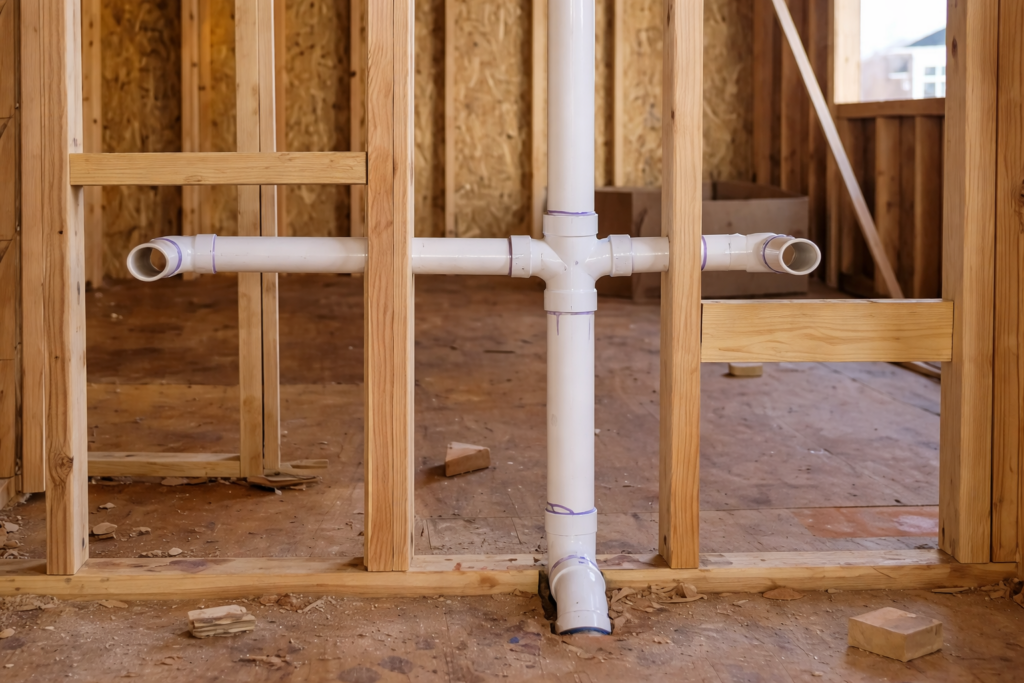
Bathrooms concentrate more plumbing connections into a small area than any other room, and most concealed leaks in a home originate there. Tub and shower valves sit inside the wall with no access panel in many builds, and the valve body, the stub outs, and the shower arm connection are all potential leak points. A worn valve cartridge usually drips out the spout where you can see it. A failed solder joint or a cracked valve body drips into the cavity where you cannot. Shower arms are especially vulnerable because homeowners hang shower caddies on them or over tighten the head, which loosens the threaded connection at the drop ear elbow behind the tile. If the wall outside your shower feels damp only after someone bathes, look at the arm and the escutcheon first. Silicone around the escutcheon plate is a cosmetic seal, not a waterproof barrier, so water passing behind tile is a real possibility.
Shower pans and tile assemblies fail more often than people expect, and the resulting leak looks exactly like a pipe leak from the outside. A shower pan liner has to be properly sloped and correctly sealed at the drain assembly and the curb, and mistakes made at installation can take a decade to show themselves. Grout is porous and cracks as the house settles, so water passes through the tile face into the mortar bed underneath. From there it migrates to the framing and out to the adjacent wall or the room below. Damaged or missing caulk at the joint where the tile meets the tub deck lets water run straight down the outside of the tub and into the subfloor. A simple diagnostic is to fill the tub, mark the water line, and check it several hours later, then compare that result against what happens when only the shower runs. Different results point to different failure points.
Toilets and vanities contribute their share of hidden leaks, particularly at connections that sit low and out of sight. The wax ring under a toilet seals the fixture to the flange, and a rocking toilet breaks that seal, letting waste water escape into the subfloor on every flush. That leak stains the ceiling below on a second story and rots the floor decking on a first story. Supply stops, the small angle valves under toilets and sinks, corrode and weep at the packing nut, and the braided connector lines attached to them have a finite lifespan. Tub overflow gaskets dry out and crack, releasing water inside the wall each time the tub is filled past the plate. Drain and vent connections inside the wall separate when the house shifts, and cast iron drain lines in older homes rust through at the bottom of the pipe. Every one of these problems is fixable. The trick is identifying which one you actually have before opening the wall.
Water Pressure Problems That Cause a Hidden Water Leak Behind Walls
Excessive static water pressure is one of the most overlooked causes of concealed leaks, and it is common throughout Tarrant and Johnson counties. Plumbing code generally requires a pressure reducing valve when incoming pressure exceeds eighty pounds per square inch, and many municipal systems deliver considerably more than that at the meter. High pressure stresses every joint, gasket, valve seat, and flexible connector in the house continuously. It accelerates erosion inside copper lines, shortens the life of water heaters, and makes toilet fill valves and faucet cartridges fail early. You can measure your own pressure with an inexpensive gauge threaded onto a hose bib. Take the reading with no water running, ideally at night when demand across the neighborhood is lowest and pressure peaks. Anything above eighty pounds needs a pressure reducing valve, and anything above one hundred needs one urgently.
Water hammer causes damage through a different mechanism, and you can usually hear it. When a fast closing valve like a washing machine solenoid or a single lever faucet shuts abruptly, the moving column of water slams to a stop and sends a pressure spike back through the system. That spike can momentarily reach several times the normal operating pressure. Repeated shocks loosen fittings, crack solder joints, and work pipes loose from their hangers inside walls. The banging noise is the pipe physically moving and striking framing. Properly installed arrestors near the offending fixtures absorb the shock, and secure pipe strapping keeps the lines from moving. Ignoring persistent hammering is a reliable way to end up with a concealed leak eventually.
Thermal expansion adds a quiet, constant strain that many homeowners never hear about. When water is heated it expands, and in an open system that expansion pushes harmlessly back toward the city main. Installing a pressure reducing valve or a backflow preventer creates a closed system, and that expanding water now has nowhere to go. Pressure inside the house can spike well past one hundred and fifty pounds every time the water heater fires. A properly sized and correctly pressurized thermal expansion tank absorbs that volume and protects the system. A dripping temperature and pressure relief valve on your water heater is often the first symptom of an expansion problem, not a defective valve. Left unaddressed, those daily pressure cycles fatigue joints throughout the house, including the ones hidden inside your walls. Correcting pressure and expansion issues is inexpensive compared to repairing water damage.
Why You Need Professional Leak Detection for a Hidden Water Leak Behind Walls
Guessing where a leak is located gets expensive fast. Every exploratory hole in a wall means drywall repair, texture matching, and paint, and a wrong guess costs you money without solving anything. Professional leak detection reverses that order; we locate the leak first with equipment designed for the job, then open only the small area we actually need. That approach saves material, time, and the disruption of living in a house with open walls for a week. It also produces documentation that supports an insurance claim, which matters when water damage is involved. The longer a concealed leak runs, the more it costs to make right.
How Professional Leak Detection Finds a Hidden Water Leak Behind Walls
Detection starts with a pressure test that confirms the leak exists and tells us which system it belongs to. We isolate the supply lines, hold them at a set pressure, and watch for loss over a measured interval, which separates a supply leak from a drain leak immediately. Fixtures can be isolated individually to narrow the search further. That step alone eliminates entire sections of the house from consideration. It also protects you from paying for exploratory work in the wrong room. We document the readings as we go.
From there we bring in the locating equipment. Acoustic listening devices amplify the specific frequency that pressurized water makes as it escapes a pipe, and a trained technician can trace that sound to within a small area behind drywall or under a slab. Thermal imaging cameras read surface temperature differences, which reveals the cooling effect of evaporating moisture and the warmth of a hot water line leak. Moisture meters, both pin type and pinless, map the extent of saturation across a wall so we know how far the damage has spread. Borescope cameras let us look inside a cavity through a small hole. Each tool confirms what the others suggest.
Precision is the point of the whole process. A confirmed location means one small access cut instead of several, less drywall to patch, and a faster repair. It also means we find the actual source rather than the place where water happened to surface, since water travels along framing and can appear several feet from its origin. We show you what we find and explain the options before any repair work begins. No pressure, no upselling, and no vague recommendations. Need a leak located and repaired? Click here for our water line repair service.
Repair Options After Leak Detection Finds a Hidden Water Leak Behind Walls
Once the leak is located, the right repair depends on the pipe material, the age of the system, and how many failures have already occurred. A single fitting leak on an otherwise sound line is a straightforward spot repair, often completed in a couple of hours. A pinhole in aging copper is a different situation, because the conditions that caused it exist throughout the rest of that run. We are direct with homeowners about that distinction. Patching one hole in a pipe that is going to produce five more is not a service to anyone. You get the facts and you make the call.
Section replacement is the middle option and often the smartest one. We remove the compromised run and replace it with new material rated for the application, then pressure test the repair before closing anything up. In some layouts, rerouting a line through an attic or a chase is more practical than working inside a wall or under a slab. That decision comes down to accessibility, cost, and the long term reliability of the result. We lay out the choices clearly with pricing before we start.
Whole home repiping makes sense when the system has reached the end of its usable life. Polybutylene, badly corroded galvanized steel, and copper systems producing repeated pinholes are all candidates. Repiping replaces the supply lines throughout the house, eliminating the ongoing cycle of surprise leaks and repair bills. It is a significant project, and we never recommend it lightly or as a default answer. When it is the right answer, we explain exactly why and what the process involves.
Why Choose Big Blade Plumbing and Rooter for a Hidden Water Leak Behind Walls
We have been a licensed plumbing contractor since 2007, working on residential and commercial systems across Burleson, Fort Worth, Mansfield, Cleburne, Crowley, Joshua, Arlington, and the surrounding communities. That experience covers homes built in every era of North Texas construction, from galvanized steel and cast iron to polybutylene, copper, CPVC, and PEX. We know how local soil movement, water chemistry, and municipal pressure affect each of those materials. That background makes diagnosis faster and more accurate. It also means fewer surprises once the wall is open.
Honest recommendations are the core of how we operate. You will get a clear explanation of what is wrong, what caused it, and what your realistic options are, along with straightforward pricing before work begins. We do not use pressure tactics, and we do not push a larger job when a smaller one solves the problem. When a bigger repair genuinely is the right call, we show you the evidence behind that opinion. Our reputation in Burleson was built on telling people the truth.
Water leaks do not wait for a convenient appointment window, which is why we respond quickly to plumbing emergencies. Every repair is done with quality materials and workmanship focused on long term reliability, not a temporary fix that fails again next season. We treat your home with respect, keep the work area clean, and leave you with a system you can trust. Call us at (817) 517-2425 or email info@bigbladeplumbingandrooter.com to schedule leak detection. You can find us at 2113 S Burleson Blvd, Burleson, TX 76028.