
How To Keep Outdoor Faucets From Freezing
Outdoor faucets sit on the coldest part of your house, and they hold water inside a short run of pipe that has almost no protection from wind or falling temperatures. North Texas homeowners often forget about them until a freeze rolls through and a wall starts dripping, which is exactly the wrong time to learn how the system works. The good news is that keeping outdoor faucets from freezing takes very little money and very little time when you handle it before the first cold front arrives. Late summer and early fall are the right window to walk the perimeter of your home, check every hose bib, and fix the small problems while the weather is still mild. A cracked valve body, a leaking handle, or a hose that never gets disconnected turns into a burst pipe once temperatures drop into the teens for several hours. Big Blade Plumbing & Rooter has served Burleson, Fort Worth, Cleburne, Mansfield, and the surrounding cities since 2007, and we see the same preventable failures every winter. This guide explains why outdoor faucets freeze, how to protect them correctly, and when the job needs a licensed plumber instead of a foam cover from the hardware store.
What Causes Outdoor Faucets To Freeze And Burst
Freezing damage is not really about the faucet itself; it is about the water trapped behind it and the pressure that water creates when it turns to ice. Water expands roughly nine percent as it freezes, and that expansion has to go somewhere inside a sealed pipe. The ice plug usually forms near the exterior wall where the pipe is coldest, and pressure builds between that plug and the closed faucet or valve. Copper splits along the seam, galvanized steel cracks at the threads, and PEX stretches until the fitting fails. Most homeowners never see the split on the day it happens because the ice itself is still plugging the hole. The leak shows up during the thaw, often behind drywall or under a slab, and by then the water has been running for hours. Understanding that sequence is the reason prevention works so well, because removing the trapped water removes the entire failure mechanism.
How Water Pressure Makes Outdoor Faucets Freeze And Split
The supply line feeding an outdoor faucet is pressurized at all times, usually somewhere between 50 and 80 psi in most residential neighborhoods around Burleson and Johnson County. That pressure is fine under normal conditions, but it becomes a problem when ice starts forming inside the pipe because water has nowhere to escape. As the ice plug grows, it pushes the remaining liquid water toward the closed faucet, and the pressure in that trapped section can climb into the thousands of psi. Copper tubing rated for normal household service simply cannot hold that kind of force, so it splits lengthwise along the weakest point in the wall of the pipe. The split is often small, sometimes only an inch or two long, but a crack that size will release many gallons per hour once the ice melts and full pressure returns. Homeowners frequently assume the faucet itself failed, when the actual damage sits eighteen inches back inside the wall cavity.
The location of the split matters just as much as the size of it, and this is where outdoor faucet freezes become expensive rather than annoying. A pipe that splits outside the building envelope will spray onto the ground and waste water, which is bad but visible and easy to trace. A pipe that splits inside the wall soaks insulation, framing, drywall, and flooring before anyone notices a problem. In homes built on slab foundations, which describes most of the newer construction in Burleson, Crowley, Joshua, and Rendon, that water travels along the base plate and wicks into carpet and baseboards. By the time a homeowner smells the moisture or sees a stain, the repair has grown from a simple pipe fix into drywall replacement and mold remediation. That is why we treat a frozen hose bib as an emergency even when nothing appears to be leaking yet.
Pressure damage also builds up over multiple freeze cycles instead of happening all at once, which fools a lot of people into thinking they dodged the problem. A pipe can stretch slightly during one freeze, hold together, then stretch a little further during the next cold snap two weeks later. Solder joints loosen, compression fittings lose their grip, and the brass body of the faucet develops hairline fractures that weep only under certain conditions. You might see a faucet that drips a little in February and stops in March, and that intermittent drip is often the early warning of a component that is already compromised. Replacing a damaged hose bib in the fall costs a fraction of what a burst supply line costs in January. If a faucet has already survived a hard freeze while still connected to a hose, assume it needs inspection rather than assuming it is fine. Our team can pressure test the line and tell you what is actually happening behind the wall. Need help after a freeze? Click here for our burst pipe repair service.
Why Attached Garden Hoses Cause Outdoor Faucets To Freeze
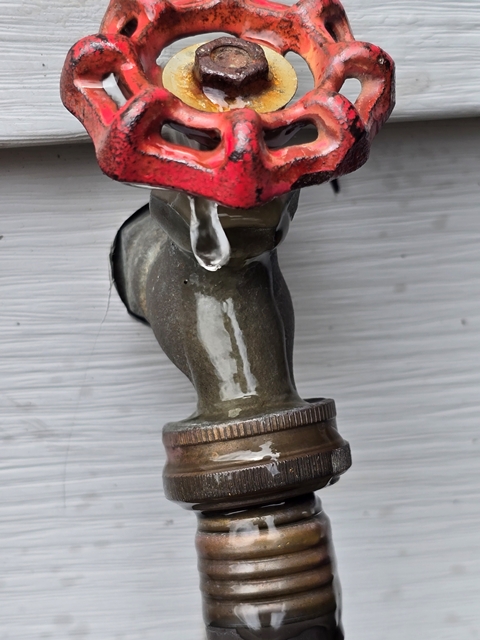
Leaving a garden hose connected through the winter is the single most common cause of frozen outdoor faucets, and it defeats even the best hardware. A frost free sillcock, which is the long stem style faucet found on most homes built in the last thirty years, works by placing the actual shutoff seat twelve to eighteen inches back inside the heated wall of the house. When you close the handle, the water stops deep inside where it stays warm, and the remaining water in the stem drains out through the spout by gravity. That drainage only happens when the spout is open to the air. A connected hose seals the spout, traps the water inside the stem, and the stem freezes exactly like a standard faucet would.
The failure that follows is particularly frustrating because the homeowner did buy the right equipment and still ended up with a repair bill. Water trapped inside the sillcock stem freezes, expands, and cracks the brass tube somewhere along its length inside the wall. The faucet often looks completely normal from outside, and it may even operate normally when spring arrives and you turn it on. Then water sprays into the wall cavity through the crack because the pressurized water now has two paths instead of one. Many people describe hearing water running inside the house with no visible fixture on. If you turn on an outdoor faucet in spring and hear rushing water inside a wall, shut off the main immediately and call a plumber.
Disconnecting hoses is free, takes about two minutes per faucet, and should happen in the fall as part of your normal seasonal routine. Drain each hose completely, coil it, and store it in a garage or shed so the hose itself does not crack from repeated freezing. Remove hose timers, splitters, quick connect fittings, and backflow devices as well, because any of those attachments will hold water against the spout just like a hose does. Check that the faucet actually drips a few tablespoons of water after you close the handle, since that small drain is proof the sillcock is pitched correctly and working as designed. A frost free faucet installed level or sloped back toward the house will never drain properly and will freeze every single year until it is corrected. That pitch problem is common in homes where the faucet was replaced by someone without plumbing experience.
How North Texas Weather Makes Outdoor Faucets Freeze Faster
Texas freezes behave differently than northern winters, and that difference works against homeowners rather than for them. In colder climates, plumbing is built with deep freeze conditions assumed from the start, with supply lines buried below the frost line and hose bibs installed with dedicated interior shutoffs. Around Burleson, Cleburne, Keene, and Alvarado, exterior plumbing is frequently run through uninsulated wall cavities and sometimes through vented crawl spaces with minimal protection. Our average winter is mild enough that these installations survive most years without any issue. Then a strong arctic front pushes down the plains, temperatures fall into the low teens for two or three days, and thousands of homes discover their weak points at the same time. February 2021 proved that point across the entire region.
Wind chill accelerates the problem in a way that surprises a lot of homeowners who watch only the forecast temperature. Moving air strips heat away from pipe surfaces far faster than still air does, so a twenty five degree night with a twenty mile per hour north wind can freeze an exposed hose bib that would survive a calm twenty degree night. Faucets on the north and west sides of a house are consistently the first to fail because they take the brunt of the wind and get the least sun during the day. Homes with open crawl spaces or unsealed foundation vents let that cold air flow directly across the supply lines feeding those faucets. Sealing vents and blocking direct wind paths makes a measurable difference in how long a pipe can hold out. Small details like a missing crawl space door matter more than most people expect.
Duration matters as much as the low temperature reading, which is why a single cold night rarely causes problems but a multiple day freeze causes many. Water inside a pipe has thermal mass, and it takes hours of sustained subfreezing air to pull enough heat out of that water to form a solid plug. Most plumbing failures in our service area happen on the second or third day of a cold snap rather than the first. That gives you a window to act even after the freeze begins, though it is far better to prepare in advance. Watch the extended forecast in November and December, and treat any predicted stretch of two or more nights below twenty five degrees as your trigger to protect every outdoor faucet. Keep in mind that unheated areas like garages, well houses, and pump sheds cool down and stay cold long after the outside air warms up. Pipes in those spaces need the same attention that exterior faucets do.
How To Keep Outdoor Faucets From Freezing Step By Step
Protecting outdoor faucets comes down to three things: removing standing water, insulating what remains, and fixing hardware that cannot drain properly. Homeowners can handle most of the first two categories in an afternoon with basic tools and about thirty dollars in supplies. The third category sometimes requires a plumber, especially when a faucet was installed incorrectly or when there is no interior shutoff valve serving the exterior line. Doing this work in early fall gives you time to order parts or schedule service before the rush that follows the first cold front. Every plumbing company in Tarrant and Johnson County books solid during a hard freeze, so waiting until the emergency arrives means waiting in line. Start at one corner of your house and work your way around so no faucet gets missed.
Draining And Shutting Off Water To Keep Outdoor Faucets From Freezing
Start by locating the interior shutoff valve that controls each outdoor faucet, since this is the most effective protection available and costs nothing to use. In many homes these valves sit in a utility closet, a garage wall, under a kitchen sink, or in a basement style crawl access near where the supply line exits the house. Turn the valve clockwise until it stops, then go outside and open the hose bib handle completely. Water will run out for a few seconds and then stop, which confirms you have isolated the correct line and drained the exposed section. Leave that outdoor handle open all winter so any water that remains has room to expand without building pressure. This single step eliminates the freeze risk for that faucet almost entirely.
Many homes in our area do not have a dedicated shutoff for exterior faucets, and that is a gap worth closing. Adding an interior stop valve with a drain port is a straightforward job for a licensed plumber and usually takes an hour or two per faucet depending on access. The valve gives you permanent control over that line, which helps during freezes and also makes future repairs easier because you will not need to shut down water to the entire house. Older homes in Fort Worth, Haltom City, River Oaks, and Richland Hills frequently lack these valves because they were built before the practice became standard. If your house predates the mid 1980s, check carefully before assuming the valve exists somewhere you have not looked. A valve that has not been operated in twenty years may also be seized or leaking, and it is better to find that out in October than during an ice storm.
For faucets that truly have no interior shutoff and cannot get one before cold weather hits, you still have options that reduce risk substantially. Open the faucet slightly during the worst of a freeze so a thin stream of water moves continuously through the pipe, since moving water resists freezing far better than still water does. This wastes some water and it is not a permanent solution, but it has saved many pipes during severe events. Combine that with an insulated cover over the faucet body to slow heat loss at the most vulnerable point. Do not rely on dripping alone during extended freezes lasting several days, because a slow drip can still freeze if temperatures stay low enough for long enough. The better long term answer is proper hardware, and that means having the line evaluated by a professional. Want a permanent fix for exposed exterior lines? Click here for our water supply lines service.
Insulated Covers And Wraps That Keep Outdoor Faucets From Freezing
Insulated faucet covers are inexpensive and effective, but only when they are installed correctly and paired with a disconnected hose. The rigid foam dome style covers work by trapping heat that radiates out from the house through the wall and around the faucet body. That trapped air pocket buys you several degrees of protection, which is often enough to carry a faucet through a normal Texas cold snap. The cover must seal tightly against the siding or brick, with the retaining cord pulled snug behind the spout so wind cannot lift the edge. A loose cover flapping in a north wind provides essentially no benefit at all. Check them after windy days, because they blow off more often than people realize.
Soft insulated pouch covers work as well as the rigid domes and fit better around unusual faucet shapes or nearby obstructions. For faucets with a vacuum breaker on top or an odd bracket configuration, a pouch style cover is usually the easier fit. Either type should be installed after the hose is removed and after the faucet has been allowed to drain, since covering a faucet with water trapped inside just insulates a block of ice. If you have already shut off the interior valve and drained the line, a cover adds a second layer of protection at almost no cost. In areas with heavy wind exposure, some homeowners add a wrap of foam pipe insulation on the exposed section of copper before installing the cover. That combination handles all but the most extreme conditions.
Insulation matters just as much on the interior side of the wall, and this is the part most homeowners skip entirely. Trace the supply line back from each outdoor faucet and look for spots where it runs through an unheated garage, an attic space, a crawl space, or an exterior wall cavity with little insulation behind it. Foam pipe sleeves slide over copper and PEX easily and cost a few dollars per section, and they meaningfully slow the rate at which heat leaves the water inside. Pay attention to elbows, tees, and valves, since those fittings are often left bare when someone insulates a straight run and they become the coldest points in the system. Seal any gaps in the exterior wall where the pipe passes through, because a small opening lets cold air blow directly onto the pipe and undo all your other work. Expanding foam or silicone caulk handles those penetrations well. This kind of preparation protects your entire plumbing system, not just the faucet at the end of the line.
Upgrades And Repairs That Keep Outdoor Faucets From Freezing For Good
Replacing an old compression style hose bib with a properly installed frost free sillcock is the most reliable upgrade available for exterior faucets. The replacement puts the shutoff seat well inside the heated envelope of the house, where freezing conditions never reach it under normal circumstances. Proper installation requires the correct stem length for your wall thickness and a slight downward pitch toward the exterior so the stem drains completely every time. A twelve inch stem in a wall that needs an eighteen inch stem leaves the shutoff seat inside the cold cavity, which recreates the exact problem you were trying to solve. This is a common mistake on homes where a previous owner or handyman handled the swap. A licensed plumber will measure the wall assembly and select the right unit.
Existing frost free faucets sometimes fail to drain because of settling, poor original installation, or debris blocking the spout. Test yours by closing the handle after running water and watching for that brief trickle from the spout over the next few seconds. No trickle means no drainage, and no drainage means the stem holds water through every freeze. Repitching the faucet usually involves opening the interior wall or accessing the connection point from a crawl space, then resetting the fitting at the correct angle. It is not a large job, but it needs to be done right the first time because access is the expensive part. Fixing a drainage problem in October is far cheaper than repairing water damage in January.
Corroded, leaking, or wobbly hose bibs should be replaced rather than patched, since a faucet that already leaks will leak far worse after a freeze cycle stresses it further. Look for green corrosion on brass, white mineral crust around the handle packing, or movement in the faucet body when you turn the handle. Any of those symptoms points to a component nearing the end of its service life. While a plumber is replacing the faucet, that is also the right time to add the interior shutoff valve if one does not exist. Bundling the work saves labor because the wall or crawl space is already open and the water is already shut down. Homes with multiple aging hose bibs often benefit from replacing all of them in one visit rather than one at a time over several years. If the supply lines feeding those faucets are also original galvanized steel, replacement may be worth discussing during the same conversation. Concerned about aging supply piping throughout the house? Click here for our repiping service.
Why You Need A Licensed Plumber To Keep Outdoor Faucets From Freezing
Some of this work is simple homeowner maintenance, and we encourage everyone to disconnect hoses and install covers on their own. Other parts of it involve opening walls, soldering copper, setting valves, and correcting installation errors that were baked in years ago. A licensed plumber brings the tools to find problems you cannot see and the training to fix them so they stay fixed. Big Blade Plumbing & Rooter has worked on homes and businesses throughout Burleson, Fort Worth, Arlington, Mansfield, Keller, Euless, Bedford, Hurst, and the surrounding communities since 2007. We give straight recommendations without pressure, and we tell you when something can wait as readily as we tell you when it cannot. Getting ahead of freeze season now means you are not calling anyone at midnight in January.
Signs You Need Help Keeping Outdoor Faucets From Freezing
Call a plumber when an outdoor faucet drips constantly even with the handle closed tight, since that usually indicates a worn seat or a damaged stem inside the wall. A faucet that will not shut off completely also cannot drain completely, which puts it at high risk during the first hard freeze. Another warning sign is a faucet handle that turns with unusual resistance or feels gritty, which often points to corrosion inside the valve body. If water sprays from around the handle when the faucet is running, the packing has failed and the unit needs service. None of these problems get better on their own, and freezing weather turns each of them into a much larger repair.
Reduced water pressure at an outdoor faucet after a cold snap deserves immediate attention rather than a wait and see approach. Pressure loss frequently means a partial blockage from ice or a crack that is diverting water somewhere it should not be going. Listen for running water inside the house with all fixtures off, and watch for damp spots on interior walls or unexplained increases in your water bill. Any of those signs together with recent freezing weather suggests a broken line behind the wall or under the slab. Shutting off the main and calling for service quickly limits the total damage. Need to find a hidden leak fast? Click here for our leak detection service.
Homes without any interior shutoff for exterior faucets should get one installed before winter arrives, and that is a job for a professional. The same goes for any house where the supply line to a hose bib runs through an unconditioned space with no insulation and no easy access. A plumber can evaluate the entire run, add valves where they make sense, and insulate the sections that actually need it. That visit often reveals other issues nearby, like an unsupported pipe or a fitting that has been slowly weeping for months. Catching those problems during a planned appointment is always cheaper than finding them during an emergency.

What Happens When Outdoor Faucets Freeze And Burst
A burst supply line releases water at full household pressure, which means several hundred gallons per hour flowing into your home. In a slab home that water spreads across the floor and soaks into flooring, cabinets, and baseboards within minutes. Drywall wicks moisture upward, insulation loses its value once saturated, and wood framing begins absorbing water that takes weeks to dry out. The repair scope grows quickly from a plumbing fix into a construction project involving multiple trades. Most homeowners are shocked at how much damage a small crack can do overnight.
Insurance may cover sudden water damage, but coverage frequently depends on the cause and on how the situation was handled. Claims involving frozen pipes sometimes face scrutiny about maintenance and preparation, and deductibles on water damage claims are often substantial. Even a covered claim costs you time, displacement, and the hassle of coordinating repairs across several contractors. Prevention that costs under a hundred dollars protects you from a claim that could run into the thousands. That math is why we push so hard on fall preparation with every customer we talk to.
The secondary effects last longer than the initial repair, and that is what catches people off guard. Trapped moisture inside wall cavities creates conditions for mold growth that may not become apparent for several weeks. Hardwood floors cup and buckle, cabinets swell at the base, and odors linger long after the visible water is gone. Proper remediation requires drying equipment, moisture monitoring, and sometimes removal of materials that looked salvageable at first. Fixing the plumbing correctly and quickly is the first step in keeping that chain of consequences short.
Why Choose Big Blade Plumbing And Rooter To Keep Outdoor Faucets From Freezing
Big Blade Plumbing & Rooter has been a licensed plumbing contractor since 2007, serving both residential and commercial customers across Burleson and the greater Fort Worth area. We handle outdoor faucet replacements, interior shutoff valve installations, supply line insulation, burst pipe repairs, and full repiping when a system has reached the end of its life. Our team works on sewer lines, drains, water heaters, gas lines, and everything in between, so we understand how the whole system fits together rather than just the one fixture in front of us. That perspective helps us spot problems early and give you accurate advice about priorities. We are not going to sell you work you do not need.
Honest recommendations without pressure is not a slogan for us; it is how we keep customers for decades. When a faucet just needs a hose disconnected and a cover installed, we will tell you that and show you how to do it yourself next year. When a sillcock is pitched wrong and will freeze every winter until it is corrected, we will explain exactly why and what the fix involves. You get clear pricing, quality parts, and workmanship built for long term reliability. Fast response times matter during freeze events, and we plan our schedules to handle emergencies when our community needs us most.
Getting your outdoor faucets ready before winter is one of the easiest calls you will make all year. Reach Big Blade Plumbing & Rooter at (817) 517-2425 or email info@bigbladeplumbingandrooter.com to schedule an inspection. Our shop is located at 2113 S Burleson Blvd, Burleson, TX 76028, and we serve Alvarado, Cleburne, Joshua, Keene, Crowley, Rendon, Mansfield, Kennedale, Forest Hill, Everman, Edgecliff Village, Arlington, Fort Worth, and more. Book now while schedules are open and the weather is still mild. A short visit in the fall protects your home through every cold front the season sends our way.